
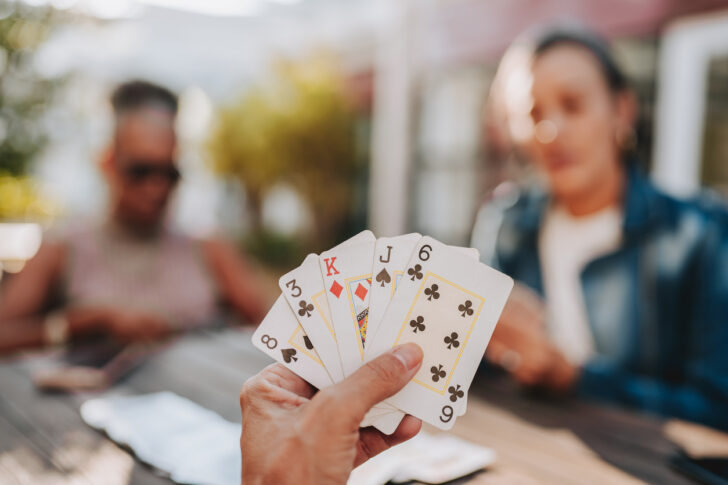
Walk into any modern casino, fire up a live-streaming platform, or browse digital gaming stores, and you could easily conclude that the world of card play begins and ends with poker. Texas Hold’em and its variations have dominated popular culture for decades, propelled by televised championship tournaments, celebrity showcases, and high-stakes online rooms. Yet treating poker as the definitive expression of card gaming overlooks a vast, centuries-old global heritage.
Long before green felt tables and casino chips became cultural fixtures, playing cards functioned as luxury art objects, philosophical allegories, social rituals, and exercises in high-level deduction. Across continents and dynasties, distinct cultures engineered their own decks, scoring mechanics, and competitive traditions. Uncovering this history reveals how human ingenuity transformed small pieces of painted paper into some of the most enduring pastimes in human civilization.
The Silk Road and the Birth of the Deck
The origin of playing cards traces back to Tang Dynasty China during the ninth century. Early historical records describe the “leaf game,” played with paper tiles or printed paper slips. By the Song and Ming dynasties, paper money games had developed where the physical cards bore denominations corresponding to ancient Chinese currency: coins, strings of coins, myriads of strings, and tens of myriads. These denominations served not only as values for play but eventually morphed into the conceptual framework of suits.
As trade flourished along the Silk Road, the concept of suit-based paper gaming migrated west through Central Asia into the Middle East. By the fourteenth century, the Mamluk Sultanate of Egypt had formalized a magnificent deck system known as Muluk Wa-Nuwwab (The Kings and Deputies). A preserved Mamluk deck discovered in Istanbul’s Topkapi Palace reveals four distinct suits: scimitars (swords), polo sticks, coins, and cups.
The Mamluk cards carried intricate geometric patterns and calligraphy, adhering to Islamic artistic traditions that avoided representational depictions of human figures. The court cards represented a strict military and royal hierarchy: the King (Malik), the First Deputy (Na’ib Malik), and the Second Deputy (Thani Na’ib). When Arab traders and Moorish influence brought these decks into southern European ports, the foundation for Western card gaming was firmly set.
The European Transformation and the Shift to Suits
When playing cards entered Italy, Spain, and Portugal in the late fourteenth century, European artisans retained the Mamluk suit structure, transforming polo sticks into ceremonial batons while keeping cups, coins, and swords. These Latin suits remain in active use across Southern Europe and Latin America today in traditional games like Brisca and Scopa.
As card making spread northward, different regions adapted the imagery to reflect their own environments and social structures:
-
German Suits: German card makers introduced acorns, leaves, hearts, and bells, swapping out Queens for an Under-Knave (Unter) and an Over-Knave (Ober).
-
Swiss Suits: Swiss workshops adopted acorns, shields, roses, and bells.
-
French Suits: French printmakers in Rouen and Lyon created the symbols recognizable worldwide: spades (pikes), hearts, diamonds (tiles), and clubs (clover leaves).
The French design represented an industrial breakthrough. Unlike the intricate, hand-painted Latin and Germanic decks, French suit symbols were stark, monochrome silhouettes. Printers could produce them rapidly using two-color stencil woodcuts, drastically lowering manufacturing costs. This manufacturing advantage, paired with French cultural dominance in the seventeenth and eighteenth centuries, eventually positioned the 52-card French deck as the global commercial standard.
The Majesty of the Trick-Taking Tradition
While gambling and betting certainly existed throughout card history, strategic competition found its highest intellectual expression in trick-taking mechanics. In a trick-taking game, players sequentially play a card from their hand, and the highest card played according to specific suit hierarchies captures the trick.
The Evolution of Whist and Bridge
In eighteenth-century England, Whist transitioned card play from rowdy taverns into sophisticated drawing rooms and intellectual clubs. Requiring strict silence, rigorous memory, and sharp partnership coordination, Whist rewarded players who could track every card played and deduce the unseen holdings of their opponents.
By the early twentieth century, Whist evolved through various forms of Auction Bridge into Contract Bridge. Standardized largely through the efforts of American businessman Harold Vanderbilt in the 1920s, Contract Bridge added an elaborate bidding phase where partners exchange subtle, legal informational bids to contract for a target number of tricks. Bridge emerged as a global competitive phenomenon, requiring a caliber of probabilistic calculation and strategic discipline rivaling international chess.
Germany’s National Game: Skat
While Bridge conquered the English-speaking world, Germany developed its own intellectual heavyweight: Skat. Invented around 1810 in the town of Altenburg by members of a local tarock club, Skat is played with a 32-card deck by three active players.
In Skat, players bid for the privilege of playing solo against a defending partnership of two. The solo player takes two hidden face-down cards (the Skat), discards two cards to their scoring pile, and declares a game type: suit games, where Jacks act as top trumps; grand games, where only Jacks are trumps; or null games, where the soloist must lose every single trick. Skat remains so culturally significant that its official rulebook is overseen by the International Skat Players Association, and its historic home of Altenburg maintains a formal card court to resolve rules disputes.
The Surprising True History of the Tarot Deck
Modern audiences universally associate tarot cards with fortune-telling, mysticism, and the occult. However, historical evidence shows that tarot originated as an aristocratic card game called Tarocchi, invented in northern Italian courts like Milan, Ferrara, and Bologna during the early fifteenth century.
The original Tarocchi decks expanded the standard four Latin suits by adding four court figures per suit (adding the Queen to the King, Knight, and Page) alongside an additional set of 21 numbered picture cards depicting allegorical, moral, and cosmic themes, plus an unnumbered card called The Fool (Il Matto).
These allegorical cards served a purely mechanical purpose in gaming: they functioned as a permanent, fifth trump suit, allowing players to outrank ordinary suited cards regardless of suit lead. Across central and eastern Europe, trick-taking games using these decks—such as French Tarot and Austrian Königrufen—have been played enthusiastically for centuries. The esoteric and divinatory use of tarot only emerged centuries later in late eighteenth-century Paris, entirely divorced from the game’s actual competitive origins.
Beyond Tricks: The Architecture of Melding and Pegging
Not all traditional masterworks rely on trick-taking mechanics. Two major historical branches developed alternative ways to think about hand management, spatial scoring, and matching patterns.
The Mathematics of Cribbage
Invented in early seventeenth-century England by the poet and soldier Sir John Suckling as an evolution of an older game called Noddy, Cribbage remains virtually unchanged to this day. Designed primarily for two players, Cribbage revolves around scoring points by recognizing specific numerical combinations: pairs, runs, flushes, and combinations of cards that sum up to fifteen.
The game is famous for its tactical tension:
-
Players receive six cards, discard two into a hidden extra hand called the “crib,” and retain four.
-
Players must weigh the strategic benefit of keeping high-scoring combinations against the danger of seeding a high-value crib for their opponent.
-
Play unfolds across two phases: the “play” (a rapid counting race to thirty-one) and the “show” (evaluating hands against a shared starter card).
-
Scores are tracked physically along a wooden cribbage board using pegs, turning every count into a visible, rhythmic race.
The Global Rummy Family and the Spanish Influence
The fundamental mechanic of gathering matched sets—three or four of a kind, or sequences of consecutive cards in the same suit—forms the basis of the Rummy family. Its direct ancestor is widely recognized as Conquian, a nineteenth-century game developed in Mexico that used a 40-card Spanish-suited deck.
Conquian spread into the American Southwest, transforming into standard Rummy and eventually spawning global offshoots:
-
Gin Rummy: A high-tempo two-player variant invented in New York City in 1909 that focused on discarding deadwood cards while minimizing points left caught in hand.
-
Canasta: Invented in Montevideo, Uruguay, in 1939 by attorney Segundo Santos and architect Alberto Serrato. Canasta used two complete decks and introduced deep partnership melding, requiring teams to construct seven-card sets (canastas) while managing an escalating discard pile.
Nature, Poetry, and Strategy in Japanese Hanafuda
Perhaps the most aesthetically striking divergence from Western card traditions occurs in Japan with Hanafuda, meaning “flower cards.”
When Portuguese traders landed in Japan in 1543, they introduced Western playing cards. The cards quickly gained widespread popularity, leading to pervasive gambling. In response, the Tokugawa Shogunate enacted sweeping bans on foreign decks. Japanese game makers repeatedly created new designs with altered imagery to circumvent the authorities, only to face successive prohibitions whenever officials recognized their underlying structure.
The eventual resolution was Hanafuda, created in the early nineteenth century. Instead of numbers, numerical ranks, or traditional court figures, a Hanafuda deck consists of 48 cards divided into twelve suits representing the twelve months of the year. Each month is illustrated with a seasonal plant alongside traditional Japanese artistic and poetic motifs:
-
January: Pine (Matsu) with the Japanese crane and rising sun
-
March: Cherry Blossom (Sakura) with an elaborate viewing curtain
-
August: Susuki Grass (Susuki) with geese flying beneath a full harvest moon
-
November: Willow (Yanagi) featuring poet Ono no Michikaze and a rain-soaked frog
In classic Hanafuda games like Koi-Koi, two players match cards in their hand to matching floral suits on the table, aiming to compile culturally thematic sets known as Yaku. Scoring combinations celebrate classical Japanese aesthetics, such as viewing the moon while drinking sake (Tsukimi-de-Ippai) or collecting the five bright cards (Gokō).
The game demands razor-sharp risk assessment. When a player completes a scoring combination, they must choose between claiming their points immediately or declaring “Koi-Koi” (come on) to continue the round in pursuit of a higher payout, risking everything if the opponent scores first. Hanafuda holds a special place in modern gaming history: it was the production of these handmade floral cards that launched Nintendo as a small Kyoto craft business in 1889.
Why Traditional Games Endure
The enduring appeal of historic card games lies in how cleanly they balance imperfect information with psychological insight. In a world increasingly saturated with digital graphics and automated calculations, sitting across from living opponents with a physical deck delivers an immediate, unmediated social dynamic.
Every shuffle introduces an entirely unique statistical arrangement, yet the human element—remembering a discard from three turns prior, reading an opponent’s hesitation, or calculating whether a crucial trump card remains buried—remains paramount. Traditional games like Bridge, Skat, Cribbage, and Koi-Koi were not built around monetary stakes; they were built to reward memory, tactical flexibility, and genuine human connection. Exploring them proves that while poker may claim the spotlight, the world of playing cards is as rich, diverse, and timeless as global culture itself.
